The Reading from the First Epistle of St. Paul to the Corinthians. (15:1-11)
In today’s epistle, the apostle Paul is writing to the church at Corinth in order to build a case. The case he is building is for the purpose of properly correcting his spiritual children and bringing order to the church. As part of this case that he builds he goes through a process of reminding, a process of remembrance regarding how we got here, what he knows to be true about the Christian faith.
For St. Paul this process of remembrance and “case building” must always center around two events, the crucifixion and the resurrection of Jesus Christ. Ultimately those are the foundation of his preaching. We see his beautiful heart for his people, for protecting them, for shepherding them through his words. “Brethren, I would remind you in what terms I preached to you the Gospel, which you received, in which you stand, by which you are saved, if you hold it fast—unless you believed in vain.”
This means that what we believe about Christ matters, truly matters. And that what we believe doesn’t matter for a short period of time. If we believe it in one moment and then we later convince ourselves or are convinced by others that we no longer believe, either of these is a kind of spiritual death according to St. Paul because either one has caused us to let go of the life raft, which is the Church of God and this life raft floats and moves through the storms of the world, the storms of this life. The life raft is powered through and held together with and made sea worthy and indestructible by the power of the Son of God, through His incarnation, His death and His resurrection from the dead. And St. Paul makes this case by giving a reminder and a warning, “this is the gospel which you received and in which you stand, and by which you are saved, if you hold it fast.” It only helps us if we continue to hold it. Once we let go, we sink and are drowned in the depths of the sea.
But in order to make his case he starts from the beginning. St. Paul reminds us of his own journey of faith, because it matters. He tells us that he delivered to the churches what he himself had received. And it is important that we see that he uses the word “delivered”. In Greek the original word is properly translated as “traditioned”. So this is one of a few instances within the New Testament where we see the place of holy tradition in the beginnings of the life of the Church. He traditioned to them what he had also received. By “traditioned” he means that he passed it by word of mouth. He breathed it to them. Just as the foundations of the universe and the beginnings of the world were made by God’s Word, so in this case the apostle reminds the people that their faith and their very salvation, their life, was made possible by his preaching, by his word.
So this aspect of our holy faith has always been there from the start of the Church. Before the gospels were recorded, before the epistles were written, before the New Testament was compiled: holy tradition, the apostolic preaching, existed. St. Irenaeus (whom we commemorate today) wrote: “We have learned the plan of our salvation from no one else other than from those through whom the gospel has come down to us. For they did at one time proclaim the gospel in public. And, at a later period, by the will of God, they handed the gospel down to us in the Scriptures…” – St. Irenaeus, Against Heresies
Now as part of that holy tradition St. Paul gives certain historical facts to further bolster his case to the Corinthians. He reminds them that the resurrection of Jesus Christ was not some kind of myth or a far off tale in a distant land. He reminds them that Our Lord Jesus Christ appeared to the pillars of the Church, people that all the Christians either knew or knew about. He mentions them publicly because they are a measure of truth. They are witnesses. They can corroborate the story. So he mentions Cephas (St. Peter), and then he mentions the twelve. Then he mentions that the Lord Jesus Christ appeared to 500 brethren together and he completes this statement with the words “most of whom are still alive, though some have fallen asleep.” What does that mean? It means that St. Paul is challenging the Corinthians to find and speak with these people if they have any doubts regarding the Christian faith. Then he mentions that the Lord appeared to James and to all of the Apostles. And finally the blessed Paul gives us the final word on the subject: “Last of all, as to one untimely born, He appeared also to me.”
He wove a defense that was built upon holy tradition in accordance with the Scriptures and he ends with the most powerful witness of all, his own experience of the resurrected Christ. He saw Jesus Christ after His death. He spoke with Him. He communed with Him. These words are powerful on their own but they become so much more powerful when we remember that St. Paul was a man who hated the Christians and who attacked and imprisoned them from town to town. So anyone who came across this epistle or who was a member of this community or any other Christian community of the time would have taken these words of St. Paul seriously. Paul meant what he said and his life after becoming a Christian was a testimony to his unwavering faith and love of Jesus Christ. Through persecutions, imprisonments, excommunications, and various trials and tribulations, St. Paul proves that he encountered the living Jesus and that for Jesus alone, he could suffer anything and everything through God’s grace.
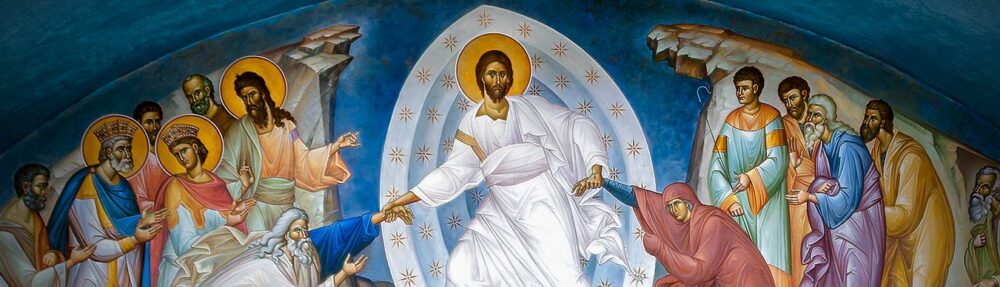
Through the witness of St. Paul, who wrote over half of the New Testament we are invited to enter into this same life with him. Suffering and struggling together, praying and growing together in love for one another and love for God. And we are reminded that you must never ever, ever let go of your faith and your hope in the crucifixion and the resurrection because Christ saves those who hold His hand and never let go. This was what St. Paul received and handed down to us and what continues to be offered to us through the Church. Once again quoting St. Irenaeus, “One should not seek among others the truth that can be easily gotten from the Church. For in her, as in a rich treasury, the apostles have placed all that pertains to truth, so that everyone can drink this beverage of life. She is the door of life.” -Against Heresies, III.4
May we enter through her doors into life, into salvation, into resurrection, into the kingdom. AMEN.
Source: Sermons